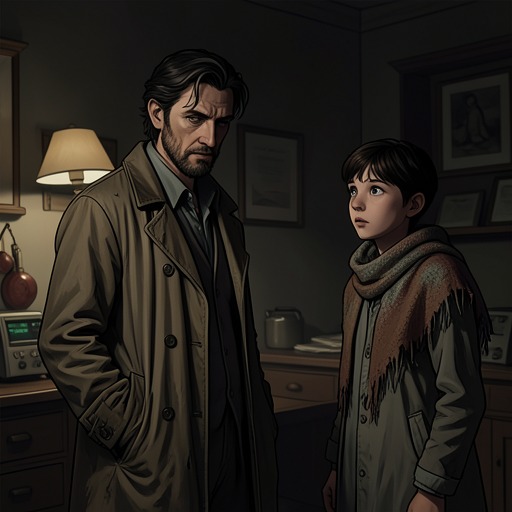
Raskolnikov’s encounter with the intoxicated girl
Crime and PunishmentRodion Romanovitch Raskolnikov’s encounter with the intoxicated girl turns a brief attempt at rescue into a sharp demonstration of his unstable relation to compassion. He recognizes that a vulnerable young woman may be in danger, calls on a policeman to help her, and gives money for a cab; then, without any change in the apparent danger, he orders the officer to leave her alone. The reversal makes the episode more than a street-side intervention: it exposes the pull of concern and the force of Raskolnikov’s effort to disown it.
The Girl on the Boulevard
A recurring thought has just returned to Raskolnikov in a newly menacing form. He feels a hammering in his head and darkness before his eyes, searches for somewhere to sit, and walks along K Boulevard toward a seat about a hundred paces away. He is accustomed to moving through the streets without attending to his route, but the woman ahead gradually arrests his attention. At first he notices her reluctantly; then he becomes intent on discovering what seems so strange about her.
She is a girl of perhaps fifteen or sixteen, walking in the great heat without a hat, parasol, or gloves. Her light, silky dress is askew and torn open near the waist, a piece hanging loose; a kerchief lies crooked around her bare throat. She staggers from side to side, and when she reaches the seat she drops into its corner, lets her head fall back, and closes her eyes in exhaustion. Raskolnikov sees that she is completely drunk. Her flushed, swollen-looking face and unsteady, indecorous movements make her seem scarcely aware that she is in the street. The scene gives her vulnerability concrete form in her disordered clothes and impaired movements, rather than presenting danger as a mere suspicion detached from what he sees.
A Threat and an Attempted Intervention
Raskolnikov does not sit down. He stays facing the girl, unwilling to leave her, and notices a well-dressed, stout man standing about fifteen paces away. The boulevard is little frequented, and at two o’clock, in the stifling heat, it is deserted. The man appears to have followed the girl and waits impatiently for Raskolnikov to move. Raskolnikov reads his intention as unmistakable and becomes furious, wanting to insult him. He walks toward him with clenched fists and calls him Svidrigailov, though he also says he does not know the man and has seen him for the first time.
A policeman intervenes before the confrontation becomes a fight. Raskolnikov seizes the opportunity, identifies himself as a student, and brings the officer by the arm to the seat. He lays out what he believes has happened: the girl has been given drink and deceived, perhaps for the first time; someone has put her into the street in clothes she could not have arranged herself. He points to the man’s watching and following, and to his apparent readiness to take her away while she is helpless. Raskolnikov’s account distinguishes what he has directly observed from what he infers, but he insists that the man’s purpose is plain and asks how they can keep the girl out of his hands and get her home.
The policeman understands the situation quickly. He examines the girl more closely, responds with genuine compassion, and recognizes that she appears to be a child who has been deceived. When she opens her weary eyes, she looks blankly at him and waves him away. Raskolnikov searches his pocket, finds twenty kopecks, and hands the money to the policeman for a cab, identifying the unresolved practical problem: they must first learn where she lives. The officer takes the money and promises to fetch a cab and take her home himself, but the girl does not give an address; she mutters that they will not leave her alone.
The Girl Leaves; Raskolnikov Reverses Course
Raskolnikov continues to press the immediate danger, pointing out that the man remains nearby. The man hears the accusation, restrains his anger, and moves farther off before stopping again. The policeman tries once more to question the girl. She suddenly opens her eyes fully, looks intently at him as if she has understood something, gets up, and walks back in the direction from which she came. Still staggering, she complains that shameful people will not leave her alone. The well-dressed man follows along another avenue, keeping her in sight.
The policeman sets off after them and assures Raskolnikov that he will not let the man have her. At that moment, Raskolnikov experiences a complete revulsion of feeling. He calls the officer back and tells him to let the girl go, asking what the matter has to do with him and dismissing the prospect of the man amusing himself. The officer stares at him in bewilderment, then walks after the girl and the man, apparently taking Raskolnikov for a madman or something worse. The girl’s departure has not resolved the danger; what changes is Raskolnikov’s willingness to take responsibility for it.
The Cost of Compassion and Its Renunciation
Left alone, Raskolnikov angrily fixates on the twenty kopecks the policeman has taken. He imagines that the officer might as well extract money from the other man in return for allowing him the girl, and turns the intervention into a series of accusations against himself: why did he interfere, was it his place to help, and did the money even belong to him? His concern has not simply vanished. The decision to withdraw is followed by distress, and he sits on the deserted seat unable to fix his thoughts on anything. He longs to forget himself and everything else, then wake and begin life anew.
His imagination nevertheless continues to follow the girl after she is gone. He foresees her coming to herself and weeping, her mother discovering what happened, beating her, and perhaps turning her out. Even if she remains at home, Raskolnikov imagines that people who prey on girls will learn of her vulnerability and that she may begin slipping out secretly. He projects a sequence of hospital, drink, taverns, and further hospital stays, ending in ruin by eighteen or nineteen. This is his prediction, not a narrated account of what later happens to her; its force lies in how quickly he turns one observed encounter into an anticipated life of repeated harm.
That forecast makes the withdrawal especially uneasy. Raskolnikov can see the social path by which a girl in her position might be exploited and ruined, and he has already tried to interrupt it with the policeman and his own money. Yet he rejects the role of helper as soon as the girl resists and the immediate task becomes uncertain. The episode ends not with a rescue or a confirmed assault, but with the girl walking away, the officer following, and Raskolnikov left alone with both the twenty-kopeck loss and the consequences he imagines. The contrast between his urgent protection of her and his insistence that her fate is none of his business gives the scene its decisive significance.